Architecture review that reads the design.
Daedalus reads the design document or drawing an application team sends, matches it to an approved blueprint, checks every control it is held to, and pins each finding to the component or flow it concerns. The review board decides on evidence it can see.
0:00One file in. A decision out.
A team sends one thing: the low-level design with its drawing inside, or the drawing on its own. Seven agents read it, hold it against the blueprint and the standards, and prepare the decision. A named person makes it.
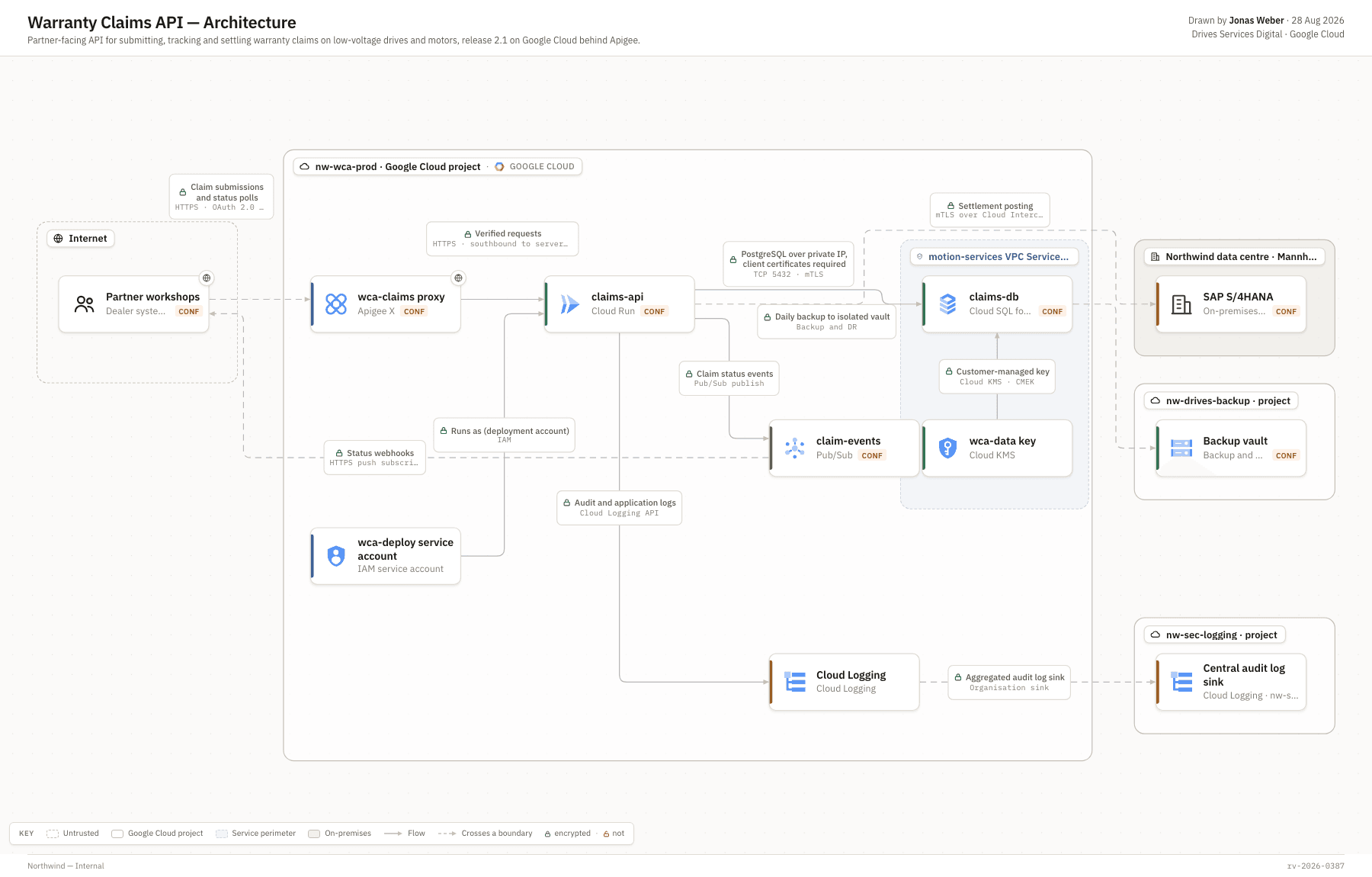
01ReadThe Reader lifts the drawing from the page, names every component against the estate catalogue, and traces each flow, its protocol and whether it is encrypted.
02MatchThe Blueprint Matcher finds the closest approved blueprint, states its confidence, and lists where the design deviates and what each deviation risks.
03CheckThe Policy Finder retrieves the passages each control rests on. The Control Checker decides Pass or Fail with the evidence and its confidence, across six parameters.
04TraceEvery finding is pinned to the component or flow it concerns. Where the document and the drawing disagree, the Consistency Checker says where.
05DecideThe Advisor proposes fixes and the corrected architecture; the Reporter writes the summary. The chair approves, approves with conditions, or requests changes.
Reads what the team actually has.
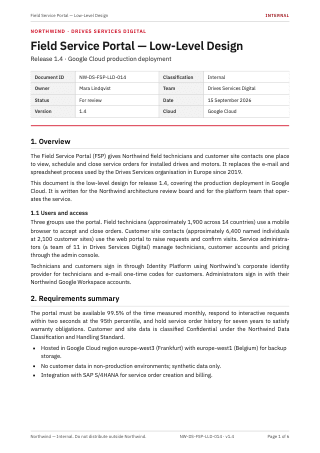
Teams keep a design document with the drawing inside it, or they keep the drawing. They do not keep both. Daedalus takes whichever exists and says which one it read.
Held to the standards the board names.
Security is scored against CIS Controls v8.1 and, for AI applications, the OWASP LLM Top 10. The other parameters are held to the provider's own framework — Google Cloud, Azure or AWS — with the estate's baselines on top. Every control shows the passage it rests on.
Pass 100 · Fail 0 · score = weighted mean by parameterA control passes or it fails. There is no third state to hide in, and nothing passes on silence.Northwind, from the Google, Azure and AWS frameworks · 25 questions · reviewed quarterlyCenter for Internet Security · v8.1 · June 2024National Institute of Standards and Technology · v2.0 · February 2024OWASP Foundation · 2025 edition · November 2024National Institute of Standards and Technology · Revision 5 · September 2020, with Release 5.1.1 updatesISO/IEC JTC 1/SC 27 · Third edition · October 2022, with Amendment 1 (2024)Google Cloud · 2025 edition · continuously publishedMicrosoft · Current edition · continuously publishedAmazon Web Services · Current edition · continuously publishedEvery design is held against a blueprint the architecture office approved.
A blueprint is a reference architecture drawn in the same space as a review: the graph, the controls a design of that shape must satisfy, and the guidance the Advisor cites when a design deviates from it. One was assembled by Daedalus from reviewed designs that all failed the same way.
Google Cloud · 10 controls · cited in 14 reviewsGoogle Cloud · 17 controls · cited in 3 reviewsGoogle Cloud · 7 controls · cited in 6 reviewsGoogle Cloud · 8 controls · cited in 9 reviewsGoogle Cloud · 6 controls · cited in 4 reviewsGoogle Cloud · 10 controls · cited in 6 reviewsGoogle Cloud · 13 controls · cited in 2 reviewsGoogle Cloud · 10 controls · cited in 11 reviewsGoogle Cloud · 7 controls · cited in 9 reviewsGoogle Cloud · 8 controls · cited in 7 reviewsGoogle Cloud · 10 controls · cited in 5 reviewsGoogle Cloud · 16 controls · cited in 4 reviewsMicrosoft Azure · 10 controls · cited in 6 reviewsAmazon Web Services · 10 controls · cited in 9 reviewsFindings close on evidence, not on a promise.
After the decision, the application team answers each finding with what it changed: an applied plan, a policy export, a restore record. The checker reads the file, says which findings it closes, and refuses what it cannot use, with the reason.
Seven agents, each with a job and a limit.
A run is seven agents, each with one job and a bounded set of things it may read. The chair sees what each one did, what it cited and what it found, as it happens.
01ReaderTurns the document and its drawing into one architecture model.
Names only what the catalogue knows. A service it cannot place is flagged, not guessed.02Blueprint MatcherFinds the closest approved blueprint and the deviations from it.
Reports its confidence. A weak match is shown as weak.03Policy FinderRetrieves and cites the passages each control rests on.
Quotes the passage. The citation stays with the control.04Control CheckerDecides each control's status with evidence and confidence.
Pass or Fail, with evidence. Nothing passes on silence.05Consistency CheckerFinds contradictions between the document and the diagram.
Raises only a contradiction it can point at in both the document and the drawing.06AdvisorRecommends fixes and proposes the corrected architecture.
Proposes. It never changes a score or a decision.07ReporterWrites the review summary.
Summarises what the others found and adds nothing of its own.